Japanese version: Tam Lin(Eマイナー・Reel)|バンジョーTABとD管ホイッスル運指
“Tam Lin,” an Irish session reel, has been converted with ABC2Tab for D tin whistle and GDAE tenor banjo. The score shows standard notation, note-by-note whistle fingering, and banjo string and fret positions.
Session arrangement and YouTube performance
Fuller session arrangement
A local ABC2Tab arrangement that preserves the written melody and repeats while adding whistle, GDAE tenor banjo, fiddle, accordion, guitar, bass, drone, and a bodhrán-style pulse. It is not presented as generative-AI audio.
A popular performance on YouTube
A high-view performance selected after checking the tune-title match, public status, and embeddability. 767,037 views when checked on 2026-07-22.
Tam Lin – Glasgow Reel
Watch on YouTube →
Listen to the score
A practice rendition of the written melody and repeats, voiced with D whistle and GDAE tenor banjo.
Basic information
- Tune type: Reel
- Time signature: 4/4
- Key: E Minor
- Tenor banjo tuning: GDAE
- Whistle: D tin whistle (zero unsupported notes)
Both the whistle-fingering score and banjo TAB use consistent four-measure systems.
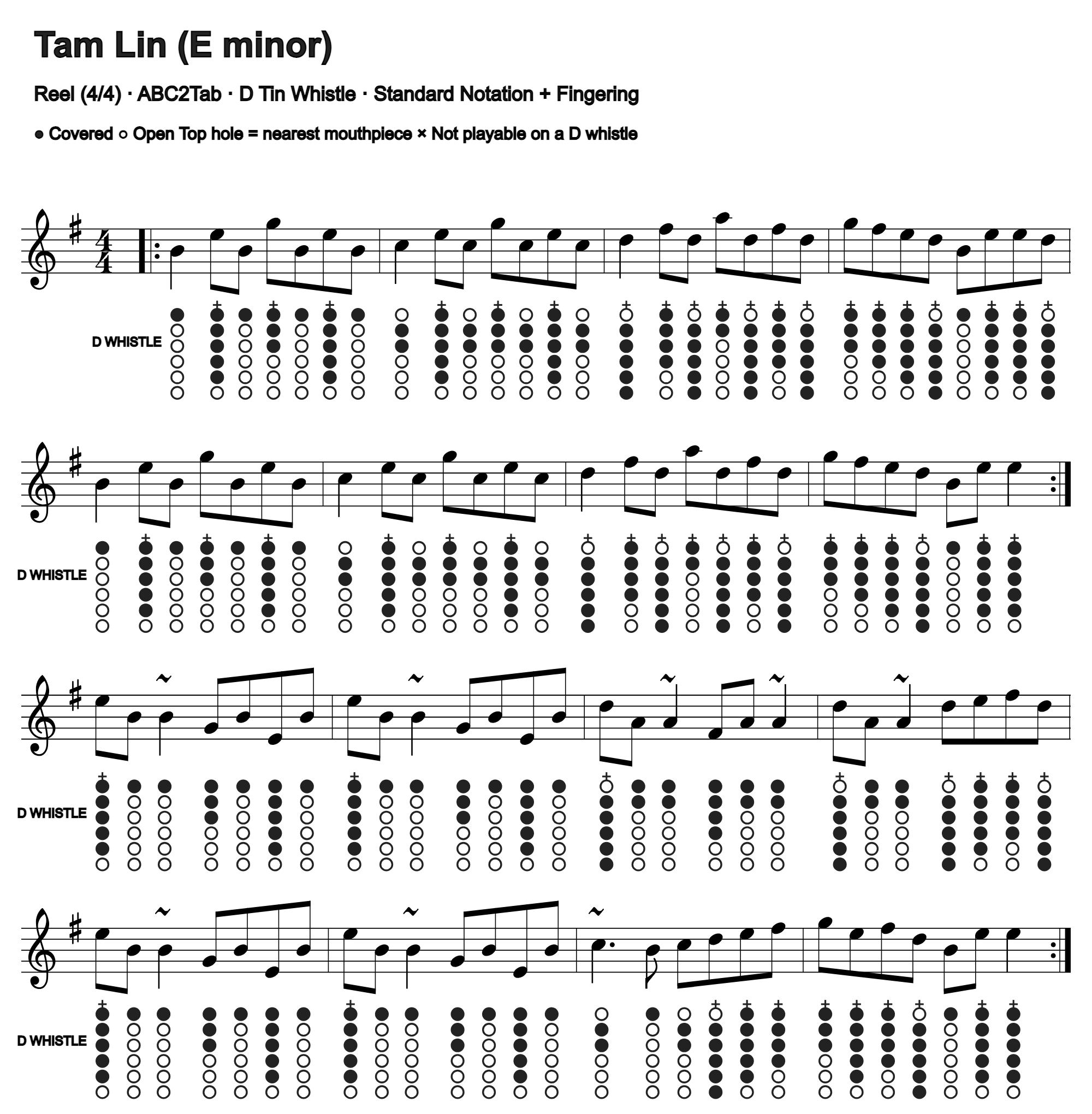
D tin whistle: standard notation and fingering
Six circles appear below every note. A filled circle means covered, an open circle means uncovered, and the top circle is nearest the mouthpiece.
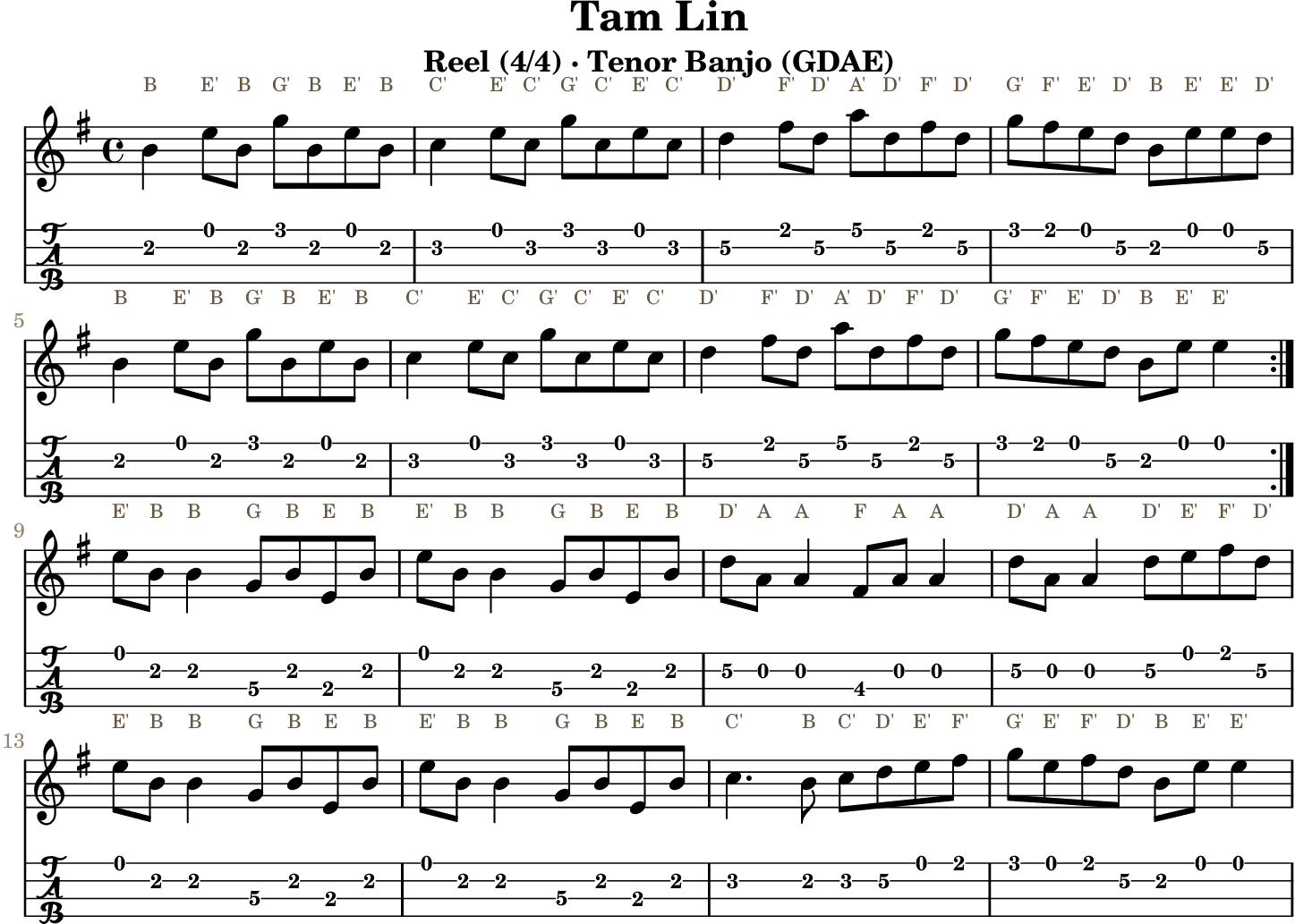
Tenor banjo: standard notation and GDAE TAB
Note names appear above the staff and TAB below it. The strings are tuned G-D-A-E from lowest to highest; numbers are frets and 0 is an open string.
How to practise
- Keep a steady 4/4 pulse and begin slowly enough to make every note even.
- Repeat each four-measure system, checking whistle fingering and banjo position separately.
- Play with the practice audio, then use the fuller arrangement to hear the complete tune flow.
Source and conversion method
The melody was checked against public setting #12961 on The Session.
Source: Tam Lin on The Session
The public ABC notation was entered into ABC2Tab and converted to D-whistle fingering and GDAE tenor-banjo TAB. This article does not reproduce The Session’s page text.
Turn your next ABC tune into something you can play.
Paste ABC notation or find a tune on The Session, then turn it into banjo TAB, whistle fingering, and more.