Japanese version: The Kesh(D調・Jig)|バンジョーTABとD管ホイッスル運指
“The Kesh” is a popular jig played in Irish traditional music sessions. Using ABC2Tab, this D-major setting has been converted for GDAE tenor banjo and D tin whistle. The diagrams show not only standard notation, but also the banjo string and fret positions and the six-hole whistle fingering for every note.
Listen to the score
Play the written melody and repeats with D whistle, GDAE tenor banjo, drone and a bodhrán-style pulse. This is a practice rendition.
Session arrangement and YouTube performance
Fuller session arrangement
A local ABC2Tab arrangement that keeps the written melody and repeats while adding whistle, GDAE tenor banjo, fiddle, accordion, guitar, bass, drone, and a bodhrán-style pulse.
A popular performance on YouTube
Selected from title-matched, embeddable performances with a high view count. 1,029,883 views when checked on 2026-07-22.
Traditional Irish Music by "The Ghillie's" — Kesh Jig set
Watch on YouTube →
Basic information
- Tune type: Jig
- Time signature: 6/8
- Key: D major
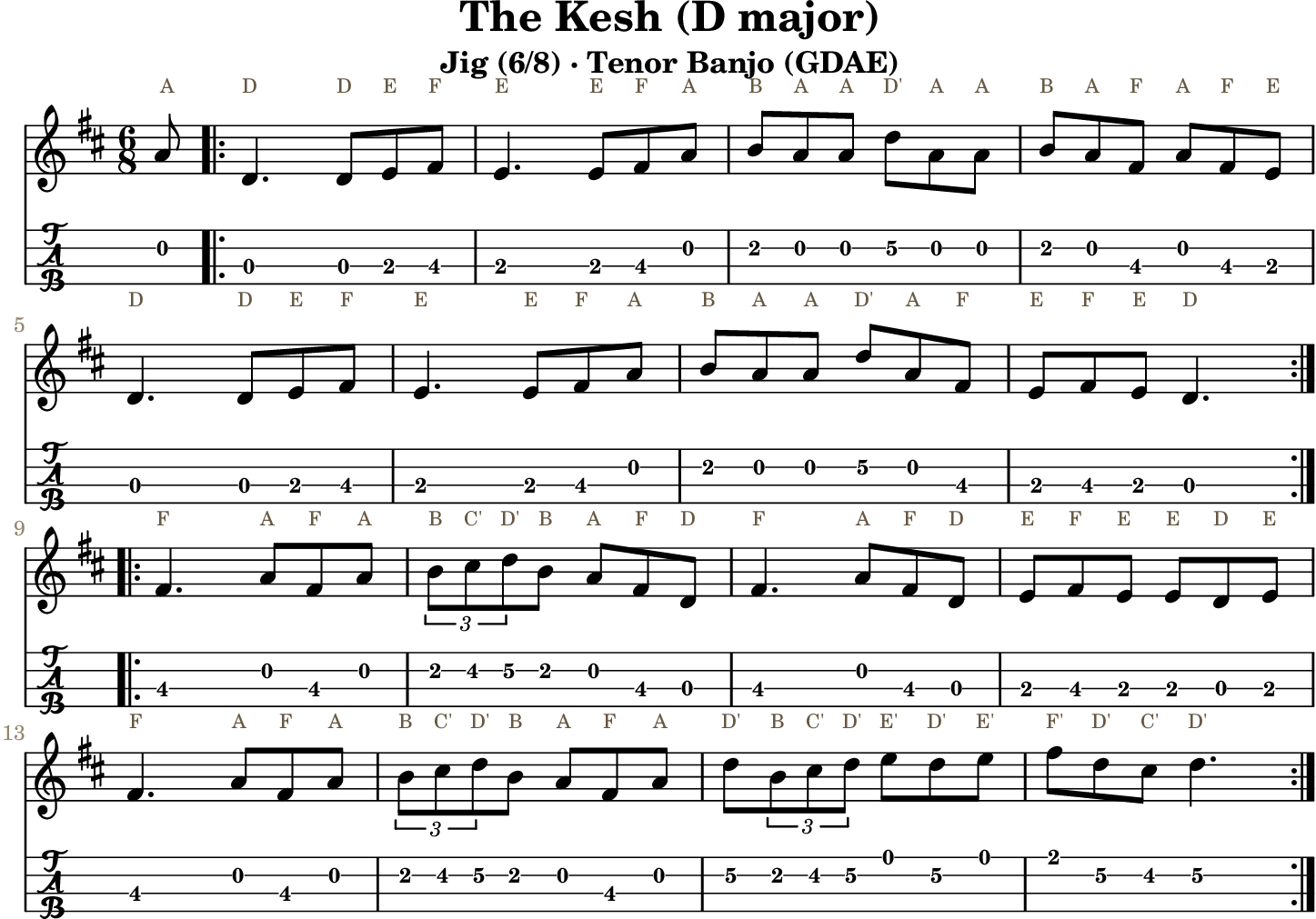
- Tenor banjo tuning: GDAE
- Whistle: D whistle
- Range: D4–F♯5
The opening A is a pickup note. It is not counted as one of the four measures in the first line, so both diagrams use four measures per line across four systems.
D whistle: standard notation and fingering
Six circles appear below each note. A filled circle means that the hole is covered, while an open circle means that it is uncovered. The top circle represents the hole nearest the mouthpiece, and the bottom circle represents the hole nearest the bell. Notes in the upper register include an octave indication where stronger air is required.
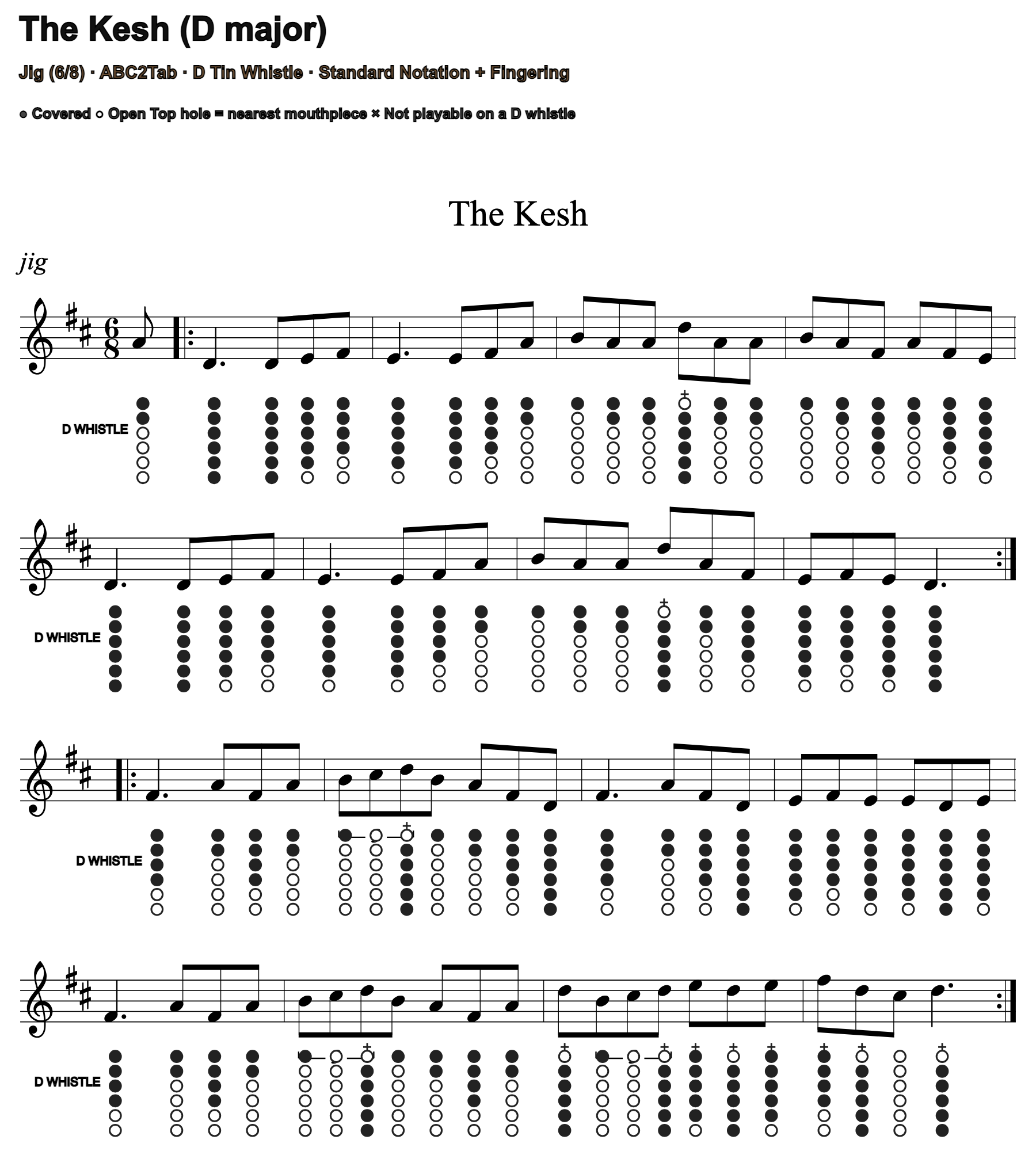
This image was rendered with ABC2Tab’s whistle notation system, which places a fingering diagram under each note. ABC2Tab does not silently replace unsupported notes with nearby pitches. Every note in this D-major setting is playable on a D whistle.
Tenor banjo: standard notation and GDAE TAB
The note names appear at the top, standard notation is in the middle, and tenor banjo tablature is shown below. The strings are tuned G–D–A–E from lowest to highest. A number indicates the fret, and 0 indicates an open string.
ABC2Tab automatically assigns a string and fret to each pitch using GDAE tuning. When connecting this tune to another tune in a set, you can move individual notes to a more comfortable position if needed.
How to practise
- Count the 6/8 rhythm as “1-2-3, 4-5-6.”
- Start by repeating only the first line of four measures on whistle or banjo.
- For whistle, check each six-hole pattern one note at a time. For banjo, check the string and fret shown in the TAB.
- After playing all four systems, return to the opening repeat and practise the tune as a session loop.
Source and conversion method
The melody was checked against a public D-major setting of “The Kesh” on The Session.
Source: The Kesh on The Session
The images in this article were produced by entering the public ABC notation into ABC2Tab’s existing conversion tools. This article does not reproduce The Session page or its user-submitted text. Because the tune has several settings, this version is limited to a D-major setting that fits a D whistle.
Turn your next ABC tune into something you can play.
Paste ABC notation or find a tune on The Session, then turn it into banjo TAB, whistle fingering, and more.